Reliable old friend and a breeze to grow: Coleus

coleusvertical350x457As we near mid-September, a dynamic and colorfully steady plant that perks up containers, hanging baskets, or resides in the ground is a cheerful sight. Consider the coleus with its color combinations of purples, reds, pinks, oranges, yellows, and greens. Its vibrant colors makes it an excellent partner to your annuals and perennials.

Now for the scientific stuff. Coleus is the common name for Solenostemon, which is part of the Lamiaceae genus of flowering plants. It is native to tropical Africa, Asia and Australia. There are about 60 species of coleus. It is grown almost entirely for its foliage and is easier to grow inside than outdoors.

To grow a coleus in a container, you’ll need:

  • good quality potting soil that is moist, but not wet.
    NOTE: Soil that is too dense may cause the roots to rot.
  • slow-release fertilizer mixed into the potting soil or a diluted liquid fertilizer.
    NOTE: Potted plants require more feeding than does the same plant in a garden bed.
  • pot or planter with good drainage.

To keep your container or garden bed coleus thriving,

  • put it in a sheltered location with full sun to partial shade.
  • ensure it is well-hydrated.
  • fertilize every 2 weeks during its active growth.
  • pinch off shoots and flower stalks to encourage a good shape to the plant.

Pinching off shoots and flower stalks is very important with coleus plants! They grow like crazy and without such attention will lose their full, lush, brightly colorful foliage. Watch this video from Brightcove for a short “how to” lesson.

//players.brightcove.net/51750002001/BygqHecGhZ_default/index.html?videoId=702071880001
(If the video itself does not appear in your browser, here’s the link to see it.)

Some remedies for what may ail your coleus:

  • Colors look washed out and dull? Move the plant to a shadier spot.
  • Losing leaves? Move the plant to a sunnier spot.
  • Mealybugs, scale insects, and whiteflies? Remove them with pest-specific spray or dust.
  • Looks “leggy” with long stems and small leaves? Pinch back the stems and snip off any blooms. This encourages the plant to put energy into growing its foliage.

At summer’s end before the first frost, get ready for next year’s bounty.

  • Cut some of your coleus stems.
  • Place them in glasses filled with water, ensuring no leaves are beneath the water level so they won’t rot.
  • Watch for the roots to begin and develop.
  • Change the water to keep it clear.
  • Leave the rooted stems in the glasses until they are ready to plant in the spring.

coleus600x450

Coleus has been described as “a good-natured plant that is pretty hard to kill and quite easy to propagate.” In short, it has the perfect qualifications to be a mainstay in my garden and hopefully yours too!

Posted in coleus | Leave a comment

Wow! What is that silvery fern in the corner? Japanese Painted Fern

fernalso350x433Among an array of shade perennials in varying shades of green, your eye can’t help but be drawn to the Japanese Painted Fern or Athyrium niponicum. This fern has been around since prehistoric times and thrives in many kinds of shady garden conditions. It does not flower. However, its signature gray-green fronds with crimson red midribs are visually striking and is best used as an accent plant in your garden or yard. At full potential, it will be 18 inches tall and 18 to 24 inches wide. The fronds are variable in length and alternately arranged on the stem. The spore-bearing sori are on the undersides of the fronds.

The Japanese Painted Fern is an easy-to-grow and hearty plant. It does best in moist, well-drained, acidic soil. If you are planting several together, plant them at least 18 inches from each other to accommodate their ultimate width. The Japanese Painted Fern prefers morning sun and rich, composted and well-draining soil. Rotting roots and disease result if it’s planted where soil drainage is poor. It requires light application of pelleted fertilizer or half strength liquid plant food. Should fronds turn brown, just trim them back.

As with other perennials, Japanese Painted Fern will multiply over time and take more space in your garden or yard. If this lovely, colored plant spreads too much, you may have to thin it or cut it back.

I fell in love with flora of all types, especially ferns. Loved the sparse structure and repetition of shape – almost fractal. by Jack Dorsey, CEO of Twitter

fern572x351

Posted in fern | Leave a comment

“Knee-high by the Fourth of July”: Predictor of a good corn harvest

cornstalkpile470x450

Photo by Bob Bowie.

Which plant is a favorite of humans, animals, vehicles, and more? Corn!

Also known as maize, corn is an annual grass in the family Gramineae. Wheat, rye, barley, rice, sorghum, and sugarcane are other grasses in this family.

Corn was first domesticated by indigenous peoples in south-central Mexico about 10,000 years ago. It florishes in diverse climates, which rapidly extended its cultivation across the globe. Maize is the most widely grown grain crop throughout the Americas, with 361 million metric tons grown in the United States in 2014. Currently, corn leads wheat and rice in total grain production world-wide. There are six major types of maize: dent corn, flint corn, pod corn, popcorn, flour corn, and sweet corn.

Corn plants can grow to 10 feet tall. Its stem is usually composed of 20 nodes of just over 7 inches in length. Each node can have a leaf, which is between 4 inches in width and 4 feet in length. These leaves end in a tassel. When the tassel is mature and weather conditions are warm and dry, they release pollen. The end of the leaves have a hair-like, pale yellow silk which can be up to 7 inches long. If a pollen grain fertilizes an ear, a kernel (or seed) develops. Individual kernels are arranged in regular rows. While the most well-known colors of kernels are yellow or white, they can be blackish, bluish-gray, purple, green, or red.

cornfield625x301

Photo by Bob Bowie.

In prehistoric times, corn cultivation yielded large plants with large ears. Over time, farmers selected highly productive varieties of corn in their fields and then sold seed to other farmers. The way corn reproduces via pollen means that desirable traits, such as high yield or good nutrition, found in one crop can be lost in subsequent generations. Seeking to avoid this roll of the dice approach for such an important crop led to research and development of corn’s genetic modification. In 2016, 92% of this country’s corn crop was genetically modified.

A successful corn crop depends on climate conditions. Its shallow roots make it susceptible to droughts, to produce poorly in soil which is either nutrient-deficient or lacks moisture, and to be uprooted by severe winds. It doesn’t do well in cold conditions, which is why here in Virginia it is planted in the spring.

Not only is corn relatively easy to grow, it is one of our most versatile crops

  • “Sweet corn” is a food staple for people in a variety of forms: eating the kernels themselves, ground into flour or cornmeal, pressed into corn oil, fermentated and distilled into alcoholic beverages like bourbon and whiskey, turned into corn starch, and boiled into corn syrup.
  • Feed for animals
  • Fuel for vehicles as corn ethanol with approximately 40% of the crop (130 million tons in 2014) used for corn ethanol.

Beyond its central place in our agricultural system, why does corn leap to mind when I think about summer? The taste and smell as I dive into a shucked ear of hot corn dripping with butter and salt and knowing that there will be more ear than one to eat.

A light wind swept over the corn, and all nature laughed in the sunshine. by Anne Bronte

Posted in food, grass | Leave a comment

Who am I? Tree whose bark can be white, grey, yellow, silver or black. I’m used for hardwood furniture, paper, syrup, and medicinal tea. I’m the Birch!

Birch trees.

Photo by Bob Bowie.

Call me a pioneer species. I thrive on uninhabited land and can re-forest open expanses rapidly. Known by the Celts as Beith, I’m the symbol of new beginnings, regeneration, hope, new dawns and the promise of what is to come. Perhaps that’s why New Hampshire has chosen me as its state tree. I flourish in temperate or cool climates from Alaska to Maine and as far south as the mountain areas in Virginia, Tennessee and Oregon.

Along with its wide geographic span, there are lots of species of birch which number from 40 to 60. Scientifically, birches are short-lived ornamental and timber trees and shrubs of the genus Betula (family Betulaceae). Each species of birch has a different lifespan, so overall birches live from 30 to 200 years. Those which are cultivated for landscape purposes generally live for 30 and 40 years. Again, species vary concerning height with most between 40 and 80 feet.

Birch trees are recognizable by their bark, which can be white, grey, yellow, silver or black in color. The bark peels off in strips in all birches except the gray birch. Young trees have smooth bark; while older ones have deep ridges. Birch have oval-shaped leaves, which are single or double serrated on the edges depending on the species. Leaves turn from green in summer to yellow in the autumn.

Caring for a birch tree is helped by knowing they do best in full sun to partial shade and love moist soil. Their root system is shallow and close to the ground’s surface. Watch those roots because if a birch is planted close to your house the roots may seek out your plumbing pipes! The best time to prune birch trees is late summer or early autumn.

Birch have many uses. Its striking pale colors, fine grain, and density of the wood make it an excellent choice for furniture. It is also favored as firewood because it burns well and doesn’t pop even when newly cut or frozen. Because the bark is lightweight and peels readily, it has been used for paper and Native Americans constructed waterproof and lightweight canoes as well as using it as home-building material. The sap can be boiled to make a syrup for pancakes and waffles, much like maple syrup. The leaves contain vitamin C and have been put to medicinal purposes to treat infections of the urinary tract and as a diuretic. Not everything about the birch is good for humans. Its pollen grains are estimated to be responsible for 15 to 20% cases of hay fever in North America. Ah choo!

When I see birches bend to left and right
Across the lines of straighter darker trees,
I like to think some boy’s been swinging them.
Birches by Robert Frost

Posted in tree, Uncategorized | Leave a comment

Humble wildflower to star of the Preakness horse race – the Black-eyed Susan

Black-eyed Susan plants.

Photo by Bob Bowie

Winning horses are draped in roses at the Kentucky Derby horse race. At the Preakness held at the Pimlico track in Baltimore, Maryland, the winners are draped in the state flower of Maryland, the Black-eyed Susan.

Rudbeckia hirta, commonly called the Black-eyed Susan, is part of the sunflower family. They are native to east and central North America. The centers are dark brown to purple with a daisy-like flower head. They are hard-working flowers attracting pollinators such as butterflies and bees, who are drawn to the nectar held in the plant’s conical center.

Plant them March to May and look forward to blooms in June to October. They are happiest in full sun with moist soil where they will flower abundantly. They grow from 1 to 3’ tall and spread 12 to 18”. The leaves are up to 6” long with stalks over 8” tall and flowers 2 to 3”. Watch out for these space hogs as they tend to overtake other flowers growing near them.

Black-eyed Susans make lovely and long-lasting cut flowers and also excel as border plants or in containers. And they are more than just a pretty face. The roots are believed to have medicinal properties according to traditional Native American medicine. The root – NOT the leaves or flowers – ease colds or flu, reduce infections and swelling.

I know a plain old-fashioned farmhouse down a pretty little lane Where yellow daisies make a pathway to the fields of golden grain. There a little girl is waiting where I found her years ago. Something tells me that I’m welcome where the Black-eyed Susans grow. ~ Al Jolson

Posted in flower, Uncategorized | Leave a comment

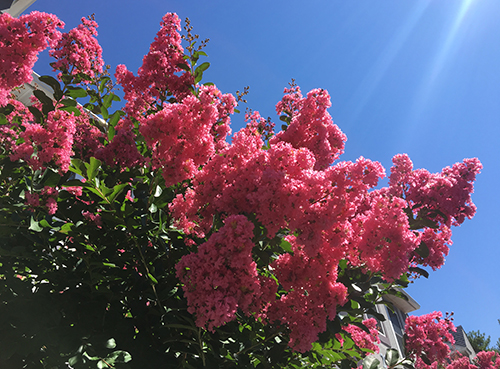
Whether you prefer crepe or crape, the myrtle is a mainstay of the Southern summer landscape.

myrtle500x370

Both photos by Bob Bowie

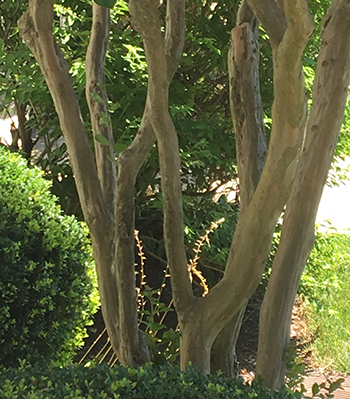
The crepe (my preference) myrtle tree boasts bright flowers, which vary from deep purple to red and white and shades in between, as well as an eye-catching mottled bark. It is a deciduous tree which blooms for 60 to 90 days in the summer.

myrtletrunk350x400Lagerstroemia, commonly known as crape myrtle or crepe myrtle, was named after the Swedish merchant Magnus von Lagerström. He was a director of the Swedish East India Company who supplied Carl Linnaeus with plants for his collection. Native to China, Japan, and Korea, the crepe myrtle was introduced to Charleston, South Carolina in 1790 by the French botanist André Michaux.

Crepe myrtles flourish and flower most heavily in full uninterrupted sunlight. They like a medium amount of water with the soil consistently moist but not soggy. Flowering is compromised by shade, frequent irrigation, lack of heat, and over fertilization. Deer seldom eat any variety of crepe myrtle. Mildew, aphids, and leaf-hoppers can be problems.

Its seed is a capsule, which is green and soft initially and then ripens to a dark brown or black dryness. These capsules release small winged seeds. In addition to starting from a seed, a crepe myrtle can be grown from a cutting of an existing tree. Here’s how. In spring or summer, take cuttings where they meet the main branch about 6 to 8 inches in length with about 3-4 nodes per cutting. Remove all the leaves except the last two or three.

Crepe myrtles bloom on new wood and should be pruned in winter or early spring. Never prune crepe myrtle in the fall and winter since it compromises their hardiness.

Watch this video on how to prune a crepe myrtle properly from Southern Living.
//players.brightcove.net/474428695/default_default/index.html?videoId=4662633204001#t=48s

In closing, a quote from The Hidden Summer by Gin Phillips that captures these gorgeous trees in season.
The blossoms are scattering off the crape myrtles every time the wind blows, falling like hot pink confetti.

Posted in Uncategorized | Leave a comment

“To every season”

littlepurpleflowers357x500This technology blog has lain fallow for several years, so I’ve decided to give it a re-boot.

The tagline “what matters about current consumer technologies”, while still personally intriguing, is no longer a strong interest of mine.  Perhaps a result of me celebrating a “big” birthday this year, I’ve looked back at the themes in my life that have held true.  Nature and natural things have been constants.

So that is this blog’s new theme with the tagline to be changed as the effort comes into sharper focus.

We’re going to discuss flowers, trees, plants, grasses, oceans, mountains, and anything else that we can see in our lives here on the East Coast of the US.

With the height of summer upon us, we’ll begin shortly.

Posted in Uncategorized | Leave a comment

Farewell Steve Jobs

I’ve just read that Steve Jobs has died. Though not the topic I intended for today’s blog entry, let’s take a break from that to thank Mr. Jobs.

He was only 56 years old. What a lot he put into those years!  From Apple computers to the Mac to the iPod to the iPhone and most recently the iPad — even the short-lived NeXT computer –, he consistently and intently created, innovated and designed beautiful products that responded to the needs of our daily lives. He raised the bar time and again.

We’ll miss his vision and for keeping us on the edge of our chairs for his next venture.

Posted in Apple | 3 Comments

Goodbye credit/debit cards? Hello Google Wallet

Going mobile makes things easier and in some regards lighter.  It may soon be time to ditch your wallet in favor of some emerging options for consumers to make payments.

Google Wallet launched on September 17. Isis is the Near Field Communications (NFC) technology standard which makes mobile payments possible.  Alternatives also using Isis are in development from HTC, LG, Motorola, RIM, Samsung Mobile and Sony Ericsson.

With $2.5 trillion annually processed in credit card payments, there is lots of interest in these emerging technologies and lots of opportunity for a variety of stakeholders.  But let’s step back from that figure to consider the potential demand for mobile payments by people who are not regular bank users such as those in developing countries where cell phone usage is high but not traditional institutional banking.

To return to the United States, there are benefits to mobile payments over traditional credit cards; i.e.

  • interaction with your spending. You see the exact amount of money being removed from your balance unlike swiping a credit card.
  • integrated shopping opportunities. Special manufacturer offers and in-store specials can be provided at a given moment based on your geographic location.
  • convenience when you shop. Less to carry and the benefit of getting the best deal on your purchases.
  • better security.  Credit cards provide a single layer of protection.  All that’s needed is your credit card, which anyone can swipe. Google Wallet has two layers of purchase protection. First is that your phone device is needed. Second is your PIN for your account.

Here’s how these new technologies work:

  • A small NFC antenna is added to your phone along with an embedded security token and software. For Google Wallet, the phone of choice is Sprint’s Nexus S 4G.
  • Tap or touch your phone to a payment terminal. For Google Wallet, these are Mastercard’s PayPass terminals and conveniently the Nexus S phone comes with the Mastercard PayPass Locator app loaded.
  • Money is automatically debited from an attached credit card. For Google Wallet, the credit card is a MasterCard issued by Citi.

Initially, all transactions are being processed by First Data. Looking ahead, Google has licensed Visa, Discover and American Express NFC specifications.

Here are the steps to make a transaction:

  • Open the Google Wallet app.
  • Enter a 4-digit PIN code to unlock it.
  • Touch the phone to the terminal to pay for an item.
  • The NFC radio transfers the money about as fast as a credit or debit card.
  • Your phone displays “Sent!”

What if someone takes your phone?

  • There is a limit of five tries to enter the correct PIN.
  • On the sixth try, the PIN needs to be reset. Your name, address and Social Security number are required before a new PIN can be established.

While the United States may be slower to adopt mobile payments than other countries because of the infrastructure heavily in place here for credit card and cash payments, predictions are that it will happen. Jupiter Research reports the “total value of mobile payments for digital and physical goods, money transfers and NFC (Near Field Communications) transactions will reach $670 billion by 2015.”


Posted in Apps, electronics, mapping, mobile, phone, shopping | Leave a comment

Are the Jetsons here? Tech devices for the home

Why was the cartoon show The Jetsons appealing?  The TV show first appeared in 1962. George Jetson and his family are eerily reminiscent of the human sit-com families we still can watch today. For me, it was Rosie who both entertained and was a bit scarey. Rosie is the household robot, who cleans and cooks.  She moves about on wheels and has a face that never changes whether she’s cleaning up after George or admonishing Elroy, the youngest Jetson.

Some of the futuristic devices shown on The Jetsons may be closer to becoming a part of your everyday life.  The IFA Trade Fair, held in Berlin earlier this month, highlighted some fascinating tech devices for the home including:

Use an app to set the temperature in your home remotely, so it will be comfy and cozy when you return. 

Turn on your washing machine remotely with another app.

Watch TV on your refrigerator.

Vacuum your carpets with a robot cleaner that avoids bumping into your furniture.

Personal favorite — a refrigerator from Samsung that tweets!  These messages note when certain staples are getting low and it’s time to re-order.

Blend TV and Internet technology and talk to your friends while watching a show on TV.

Watch TV in 3D without wearing those annoying special glasses. This offering is from Toshiba and works by sending each of your eyes images of different perspectives.

Keeping green. Several of these devices store renewable energy to use as needed. Some switch to battery mode to achieve the best energy expenditures.

Not exactly the future of home appliances that Rosie on The Jetsons enjoyed.  Still I can see her wheeling her way with authority through the kitchen.

Posted in Apps, electronics, shopping, television, twitter | Leave a comment